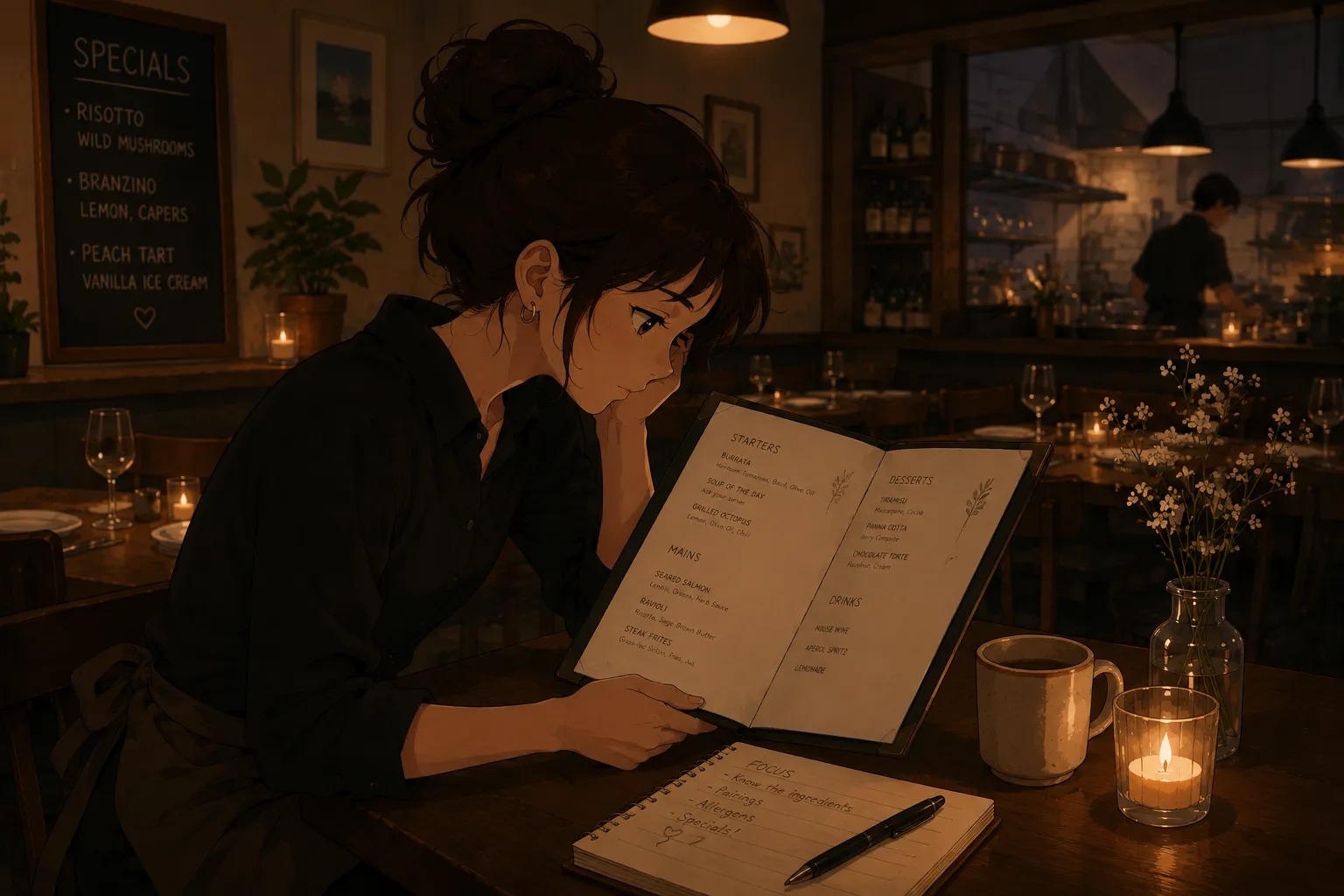
Most menu-learning advice assumes prices are the easy part. Learn the dishes, the numbers will follow. For anyone with dyscalculia that assumption is backwards: the dish names go in fine and the numbers slide straight back out, and no amount of staring at the menu fixes it.
This is a practical guide to the price half of the job when numbers do not stick the way they are supposed to. If the words rather than the numbers are the problem, server training with dyslexia covers that side.
What actually goes wrong
Dyscalculia is a specific learning difficulty affecting number sense: how numbers are held, compared, sequenced and manipulated. It is not a comprehension problem and it is not carelessness, and it does not track with intelligence or effort.
On a restaurant floor it shows up in four specific ways.
Prices will not stay attached to dishes. You know the sea bass perfectly and the number that goes with it is simply not there when asked.
Similar numbers blur. Fourteen fifty, fifteen forty, forty fifteen. The digits are all present and their order is not stable.
Mental arithmetic under pressure fails. Adding a round of drinks in your head while three people are talking is the classic failure point, and the pressure makes it much worse rather than slightly worse.
And there is the anxiety loop, which is often the biggest part. Having been caught out once, you brace for the next price question, and the bracing itself takes up the working memory the task needed.
The first reframe: you do not need most of them
The single most useful realisation is that the job does not actually require knowing every price.
Guests ask about prices far less than you fear. They can see the menu. The questions that come up are a narrow set: the specials, which are often unlisted, whether something is included, how much a supplement is, and roughly what a bottle costs.
That is a short list, and it is learnable in a way that a full price list is not.
Start by identifying which prices you genuinely need without looking. A general menu-learning routine will not do this for you, because it assumes prices come free with the dishes. On most menus it is fewer than fifteen numbers, and often fewer than ten.
| Price you may not need | Price you probably do |
|---|---|
| Every main on a printed menu | Tonight’s specials |
| Every wine on the list | The house wine, by glass and bottle |
| Every side | The supplements that surprise people |
| Dessert prices, all of them | Whether coffee is included |
| Exact totals in your head | Where to look them up quickly |
Tactics that work for price recall
These are the things that hold up under service, as opposed to the things that work in a quiet room.
Attach the number to the dish rather than learning a list. Price lists are sequences, which is exactly the format that fails, and short-term memory for unstructured items runs out quickly even without dyscalculia. A price learned as part of one dish’s card is a fact about that dish, not a position in a series.
Use the spoken form, not the written one. “Sixteen fifty” is a phrase, and phrases are held by the same machinery as dish names. Sixteen point five zero is a number, and numbers are the thing that slips. Say prices out loud when you learn them and say them out loud when you use them.
Group by band rather than by digit. Knowing that the fish are all in the low twenties and the pasta is high teens gives you a correct answer to most questions and an anchor for the rest.
Use shape and position. Many people with dyscalculia have strong visual memory. Where the number sits on the page, its length, whether it is the highest one in its block: all of that is retrievable when the digits are not.
Round when speaking, unless precision is required. “Around twenty two” is an acceptable answer to most casual questions and it removes the failure mode of transposed digits entirely. For the exact figure, look it up, which is what everybody should do anyway.
Testing yourself in the right direction
The way you practise matters more here than how long you practise.
Test dish to price, not price to dish. You will be asked “how much is the lamb”, never “what costs twenty four pounds”. Practising in the direction you will be asked is not obvious, and testing yourself in that direction is what the research on retrieval practice shows works better than review.
Test out loud. Silent recognition is a much weaker test than saying the answer, and saying it is what the job requires.
Test in short bursts, repeatedly. Number recall degrades fast with fatigue and anxiety, both of which build during a long session. Three minutes before a shift beats forty minutes on a day off, which is the spacing effect doing the work rather than willpower.
Flashcards suit this specific problem well, because they enforce recall rather than recognition and they keep dish and price attached, and distributed practice is easier to sustain with cards than with a printed list. MenuFlashcards builds cards from a photo of the menu, and putting the price on the answer side turns the price into part of the dish rather than an item in a list.
| Practice choice | Weak version | Strong version |
|---|---|---|
| Direction | Price to dish | Dish to price |
| Mode | Reading the list | Saying the answer aloud |
| Length | One long session | Three minutes, often |
| Unit | The price list | One dish, one price |
| Form | 16.50 | ”Sixteen fifty” |
Building supports that are not memory
Memory is one strategy. It is not the only one, and leaning on the others is not cheating.
Carry a written crib. A folded card in an apron pocket with the specials, the supplements and the house wine prices is completely normal in hospitality and nobody looks twice.
Learn the till, properly. Most systems will show you a price in two taps, and being fast on the till is a legitimate substitute for memorising numbers. Time spent learning the layout pays back more than time spent drilling prices.
Use the menu in front of the guest. “Let me show you” while pointing at the wine list is standard practice, not a confession. It also lets guests choose a price band without saying a number out loud, which they generally prefer.
Ask a colleague without ceremony. Every floor has someone who knows the numbers cold, and a two-second question is invisible to the table.
Never do a total in your head. Ring it in and read the total. This is good practice for everyone and it is essential here.
What to tell your manager
You do not have to disclose anything, and telling one person often makes the shift easier.
Keep it practical rather than medical. “Numbers do not stick for me, so I keep a card with the specials and I ring things in rather than adding up. Everything else is fine” is enough, and it heads off the assumption of carelessness.
Ask for the two things that actually help: the specials with prices written down before service rather than announced verbally, and an updated printed menu whenever prices change. Both are reasonable, and both help everyone on the floor.
If a workplace responds to this badly, that is information about the workplace. Most respond fine, because the alternative they are comparing it against is a server who quietly gets prices wrong.
Where the anxiety part fits
The loop is real and it is treatable by preparation rather than by willpower.
Knowing you have a crib in your pocket removes most of the bracing, because the worst case is no longer public failure. That alone improves recall, since the working memory the anxiety was consuming comes back.
Rehearsing the specials aloud once before service does the same thing. The first time you say tonight’s prices should not be to a guest.
And having a stock line for the moment it goes wrong helps more than it sounds. “Let me check that rather than guess” is a professional sentence, it is what a careful server says, and it ends the moment cleanly.
The realistic version of good
You are not aiming to recite the menu with prices. Very few servers can, and the ones who can are not better at the job for it.
You are aiming for: the specials right, the common questions answered without a pause, an honest look-up for the rest, and no arithmetic in your head. That is achievable, it is what good service looks like anyway, and it is a much smaller target than the one most menu-learning advice sets.
Specials, which are the recurring problem
Specials concentrate every difficulty in this article: the prices are new, they are usually announced out loud, and they are the prices guests are most likely to ask about because they cannot see them.
Ask for them in writing. If the kitchen briefs verbally, write them down yourself during the briefing, prices included, and read them back to someone once. Reading back is the step that catches a transposed number while it still costs nothing.
Say them out loud before service. Once, to yourself or a colleague. Prices spoken for the first time to a guest are the ones that come out wrong.
Keep the card in your pocket for the whole shift rather than trying to graduate off it by nine o’clock. There is no prize for not looking.
Working with a menu that changes constantly
Some kitchens rewrite daily. Learning prices in that environment is not a memory problem, it is a systems problem, and the answer is to stop trying.
Accept the crib as permanent rather than as training wheels. A daily-changing menu means every server is reading, including the ones who would tell you otherwise.
Build the band map instead of the list. Even on a menu that changes every day, the price bands usually do not: starters sit in one range, mains in another. Knowing the bands lets you answer “roughly how much” instantly, and roughly is what most of those questions want.
Photograph the menu each day if the tool you use allows it. Rebuilding a deck from a photo takes a couple of minutes, which is the only version of daily updating that anybody actually sustains, and it is why a photo-to-cards workflow suits this problem better than hand-typing a list.
Other numbers on the floor
Prices are not the only numeric load, and the same tactics transfer.
Table numbers. Learn them as positions rather than as a sequence, because the floor plan is spatial and your visual memory is likely stronger than your numeric memory, which is the whole argument in memorising table numbers and the floor plan. Walk the room once before service, naming tables out loud.
Covers and timings. “Table nine is on mains, table twelve is a seven thirty” is a lot of numbers to hold. Write them. Every experienced server carries a pad and the ones who do not are not doing better.
Wine vintages. Almost never actually needed, and always available on the bottle. Do not spend memory on these.
Portion counts and pour sizes. These are worth learning properly because they affect what lands on the plate, and they are few enough to drill.
| Numeric load | Strategy |
|---|---|
| Menu prices | Attach to the dish, learn as a spoken phrase |
| Specials prices | Written crib, read aloud once before service |
| Table numbers | Learn spatially, walk the room |
| Covers and timings | Write them down, always |
| Vintages | Do not memorise, read the bottle |
| Pour sizes | Drill these, they are few and they matter |
What good looks like after a month
Not a perfect price list. A short set of numbers that come out correctly under pressure, a crib you are relaxed about using, a till you are fast on, and no arithmetic happening in your head.
Servers working that way get prices wrong less often than servers relying purely on memory, which is the point that tends to surprise people. The strategies here are not compensation for a deficit, they are simply better practice that most floors never bother to adopt.
Frequently asked questions
How can I memorise menu prices if I have dyscalculia?
Attach each price to its dish rather than learning a price list, learn prices as spoken phrases such as “sixteen fifty” rather than as digits, and test yourself dish to price rather than the reverse. Group prices into bands so you always have a roughly correct answer, and practise out loud in short bursts rather than long sessions.
Do servers really need to know every price?
No. Guests can see the menu, and the prices they actually ask about are a short list: tonight’s specials, supplements, what is included and roughly what a bottle costs. On most menus that is fewer than fifteen numbers, which is a very different task from memorising the whole list.
Is it acceptable to carry a written price crib?
Yes, and it is common. A folded card with the specials, supplements and house wine prices in an apron pocket is unremarkable in hospitality. It also reduces anxiety, which improves recall, because you are no longer bracing for a public failure every time a guest opens their mouth.
What should I do about adding up in my head?
Do not. Ring items into the till and read the total, which is correct practice for everyone and essential if mental arithmetic is unreliable under pressure. Learning your till layout well is a legitimate substitute for memorising numbers and usually pays back faster than drilling prices.
Should I tell my manager?
You do not have to, and telling one person usually makes the job easier. Keep it practical: numbers do not stick, so you keep a crib and ring things in rather than adding up. Then ask for specials with prices written down before service and updated menus when prices change, both of which help the whole floor.