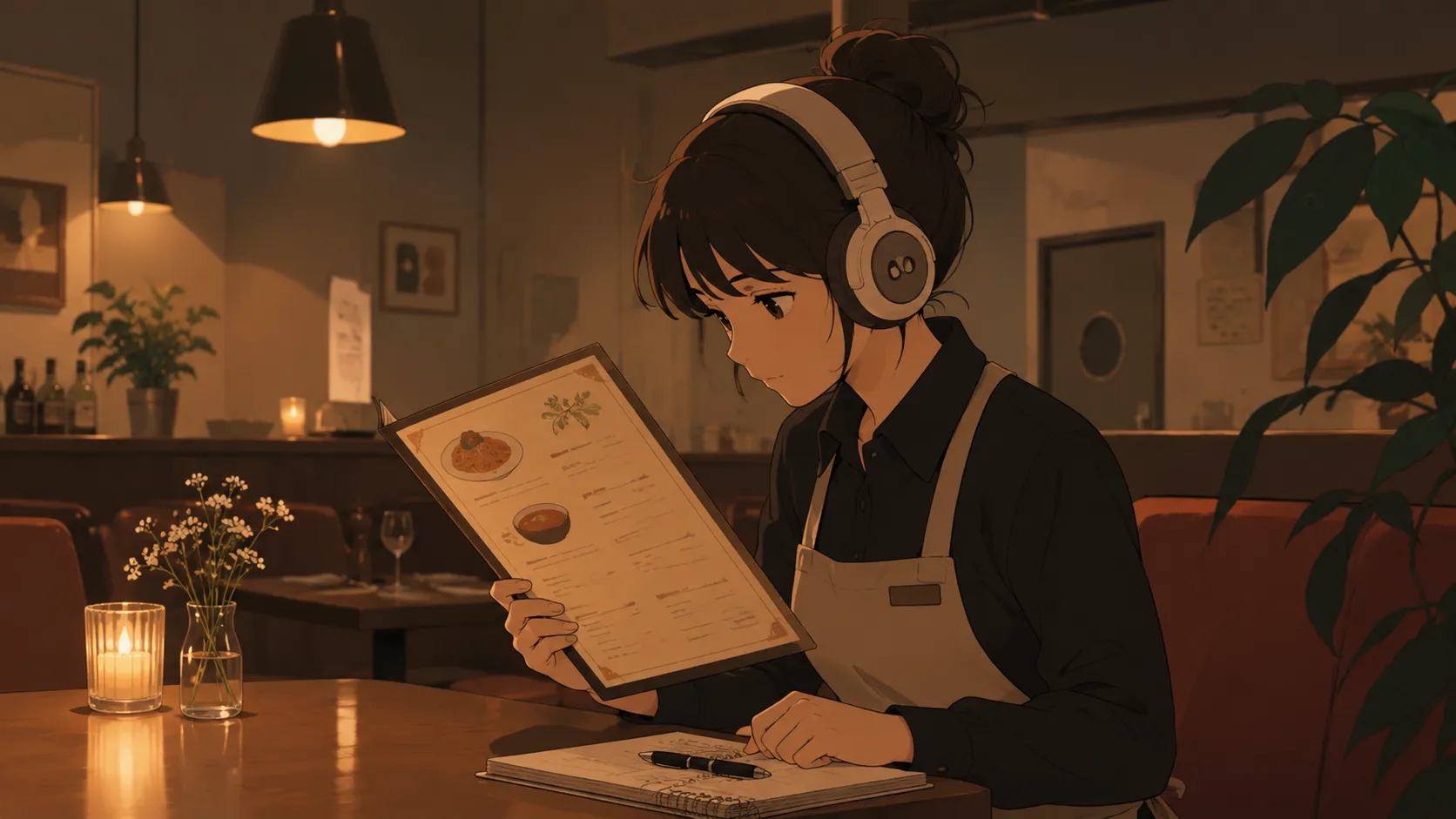
Learning a menu is a memory job. Learning a menu in a language you are still acquiring is three jobs stacked on top of each other: the words, the food they refer to, and the ability to say all of it to a stranger who is hungry and in a hurry.
Most hospitality workers in the world are doing some version of this, and almost all the advice written for them is written by people who have never had to.
The three separate problems
Untangling them is most of the solution, because each one has a different fix and mixing them makes all three feel impossible.
Comprehension. Understanding what a guest said, in an accent you may not have heard before, over restaurant noise. This is the hardest of the three and it is not a vocabulary problem.
Production. Saying the dish names, the descriptions and the standard phrases clearly enough to be understood first time.
Reference. Knowing what the words actually mean: what a parsnip is, what braised means, what the difference is between a dish you have never encountered and one you know under a different name.
The third one is invisible to native speakers and it is often the real bottleneck. You can pronounce “celeriac remoulade” perfectly and still be unable to describe it, because the problem was never the words.
| Problem | What it feels like | What fixes it |
|---|---|---|
| Comprehension | Guests seem to mumble | Predicting the small set of likely orders |
| Production | Being asked to repeat yourself | Rehearsing out loud, not reading |
| Reference | You know the word, not the thing | Seeing and tasting the dish |
Start with the fifty phrases, not the menu
Service language is far more predictable than general conversation, which is the good news nobody tells you.
Across a whole shift, most of what you say falls into roughly fifty sentences: greeting, seating, taking a drink order, checking back, describing the specials, handling the bill, apologising for a delay. Learn those as complete phrases rather than assembling them from grammar, and your comprehension of the replies improves too, because you already know the shape of the conversation.
Learn them as whole units, said aloud, exactly as you will use them. Chunking is why this works: memory holds a small number of units, and a whole phrase counts as one unit while its six words count as six. Chunked phrases come out fluently under pressure; sentences assembled word by word do not.
Then learn the guest side: the twenty or so ways a guest asks for the bill, asks what something is, or says they have an allergy. Recognising a request is much easier when you know the handful of forms it usually takes.
Then the menu, in two layers
Split every dish into what you must say and what you must understand.
The say layer is the dish name and your one-sentence description, built the way a one-sentence dish description sets out. This has to be fluent and confident, and it is a small amount of language per dish.
The understand layer is everything else: the ingredients, the method, what guests might ask about it. This can be slower and less polished because you are recognising rather than producing.
Practising them separately is much more efficient than trying to be equally good at both. Most servers need production fluency on about thirty phrases and recognition on several hundred words.
A two-sided card suits this exactly: the dish on one side, your spoken sentence plus the ingredient list on the other. MenuFlashcards builds cards from a photo of the menu, and if you work in a language you are still learning, adding your own description in your own words is the part that matters, because it is what you will actually say.
Pronunciation that matters and pronunciation that does not
Not all words are worth the same effort, and spreading effort evenly is the common mistake.
Dish names matter most, because you say them constantly and a guest cannot help you if they cannot recognise the dish. Get these right even if you have to ask a colleague ten times.
Numbers matter, because a misheard price or table number causes a real problem rather than a small awkwardness.
Allergen words matter enormously, in both directions. You must be able to say and to recognise the common ones with complete reliability, because this is the one area where a misunderstanding is dangerous rather than embarrassing. The major food allergens the FDA lists are a good vocabulary target, and what every server should know about allergens is the floor-level version.
Everything else can be imperfect. Guests are far more tolerant of an accent than most people fear, and they are not tolerant of being misunderstood about a nut allergy.
| Priority | Words | Why |
|---|---|---|
| Highest | Allergen and dietary terms | Safety, both directions |
| High | Dish names | Said constantly, must be recognisable |
| High | Numbers | Prices, tables, covers |
| Medium | Cooking methods | Needed for descriptions |
| Low | Everything else | An accent is fine |
Handling the moment you do not understand
This happens to everyone and the difference between servers is entirely in how it is handled.
Ask once, specifically. “Sorry, the fish or the chicken?” is far better than “sorry?”, because it narrows the answer and shows you were listening.
Repeat the order back. This is good practice in any language and it is essential in a second one, since it catches the misunderstanding at the table rather than at the pass.
Use the menu. Pointing is not a failure. “This one?” while indicating the line resolves the situation in one second and guests barely register it.
Get help without ceremony when it matters. For an allergy conversation you are not certain about, bringing a colleague is the professional choice, not an admission.
And do not apologise repeatedly. One apology is polite; three make the guest uncomfortable and make the interaction about your language rather than their meal.
Working in a third language, which is common
Plenty of hospitality workers serve in a language that is neither their first nor the guest’s first, which changes the calculation.
Simplify rather than elaborate. Short sentences and common words are more useful than accurate complex ones, for both of you.
Watch for the guest’s own uncertainty. A guest working in their second language will often accept a wrong dish rather than ask, so confirming clearly matters more, not less.
Learn the dish names in the language of the food rather than translating them. Guests ordering a risotto say risotto in every country.
Building the habit around shifts
Twenty minutes a day beats a weekend course for this specific job, because the material is narrow, the retrieval needs to be fast, and spaced practice outperforms massed practice for exactly this kind of learning.
Before a shift: say tonight’s specials out loud, twice. This is the single highest-value five minutes available to you.
During a shift: note down every word or phrase you did not understand, in the moment, on a pad. Two or three per shift is normal and they are the most valuable vocabulary you will ever collect, because they are the words your actual guests actually use.
After a shift: look those up and add them to your cards. This turns the job itself into the study material.
Weekly: drill the dish names out loud with the menu covered, testing yourself in the direction you will be asked, since retrieval beats review in every study that compares them.
What improves fastest, and what takes longer
Production improves quickly. Within a few weeks of saying the same fifty phrases, they come out fluently, and this is the part that changes how guests treat you.
Comprehension improves slowly and unevenly, because it depends on accents and noise as much as vocabulary. Expect this to take months, and stop treating each failure as evidence of no progress.
Reference knowledge improves whenever you eat the food, which is the argument for a menu tasting the floor actually remembers, which is why staff meals and tastings are worth more to you than to anyone else on the floor. Ask to taste things. Most kitchens will say yes and most people never ask.
The allergen conversation, in detail
This deserves separate treatment because it is the one exchange where a language gap has consequences beyond awkwardness, and because it is entirely learnable as a fixed script.
Learn the allergen list in both directions. You need to recognise the word when a guest says it, in various accents and phrasings, and you need to produce it when you talk to the kitchen. Recognition alone is not enough.
Learn the phrasings guests actually use, which are rarely the clinical terms. “I am allergic to”, “I cannot have”, “I am intolerant to”, “does that have any”, “she reacts to”. Several of these are easy to miss in a noisy room if you are only listening for the word allergy.
Have one fixed sentence for confirming. Something like “so no dairy at all, including butter” said back to the guest, every time. A fixed sentence is reliable in a way that improvised language is not, and it catches the difference between a preference and a medical allergy.
Have one fixed sentence for the kitchen, in the same form each time. Consistency here matters more than elegance.
And when you are not fully certain what was said, bring a colleague. This is not a failure and every experienced server does it occasionally in their own first language.
Accents, noise and the things that are not vocabulary
A common and demoralising experience: your vocabulary is fine, your grammar is fine, and you still cannot understand table nine.
That is usually not a language problem. Restaurant rooms are loud, guests speak while looking at a menu rather than at you, regional accents vary enormously, and groups talk over each other. Native speakers mishear orders constantly and simply do not treat it as evidence of anything.
Two practical adjustments help more than more study. Stand where you can see the guest’s face, since a large amount of comprehension is visual. And take orders in a fixed sequence around the table rather than as people volunteer them, which lets you predict what is coming.
Written language on the job
Tickets, prep lists, allergy notes and handover messages are their own vocabulary, and they are full of abbreviations that appear in no textbook.
Ask for the abbreviation list on your first week. If reading is its own obstacle, server training with dyslexia has tactics that transfer. Every kitchen has one and most have never written it down, which is exactly the kind of thing worth adding to your own cards.
Write your own notes in whichever language is fastest for you. Nobody else needs to read your pad, and speed matters more than consistency.
The exception is anything another person will act on: allergy notes, handover states, messages to the kitchen. Those go in the house language, clearly, every time.
Frequently asked questions
How can I learn a restaurant menu in a second language?
Split it into a say layer and an understand layer. The say layer is the dish name and one spoken sentence per dish, which must be fluent and is a small amount of language. The understand layer is ingredients and methods, which only needs recognition. Practise them separately, out loud for the first and by reading for the second.
What should I learn first as a server working in a second language?
The roughly fifty service phrases you use every shift: greeting, taking an order, checking back, describing specials, handling the bill and apologising for a delay. Learn them as complete chunks rather than assembling them grammatically, because chunked phrases survive pressure and assembled sentences do not.
Which words are worth the most pronunciation effort?
Allergen and dietary terms first, because misunderstanding those is dangerous rather than awkward, and you need both to say and recognise them reliably. Then dish names, since guests cannot help you if they cannot recognise what you said, then numbers. Everything else can carry an accent without any real cost.
What do I do when I cannot understand a guest?
Ask once and specifically, such as “sorry, the fish or the chicken”, which narrows the answer and shows you were listening. Repeat the order back, and point at the menu if that resolves it faster. Apologise once rather than repeatedly, because repeated apologies make the interaction about your language rather than their meal.
How long does it take to feel comfortable?
Production comfort arrives in weeks, because the fifty service phrases repeat constantly and become automatic quickly. Comprehension takes months, since it depends on accents and background noise rather than vocabulary, and it improves unevenly. Knowing what the dishes actually are improves fastest by tasting them, which is why staff meals matter.