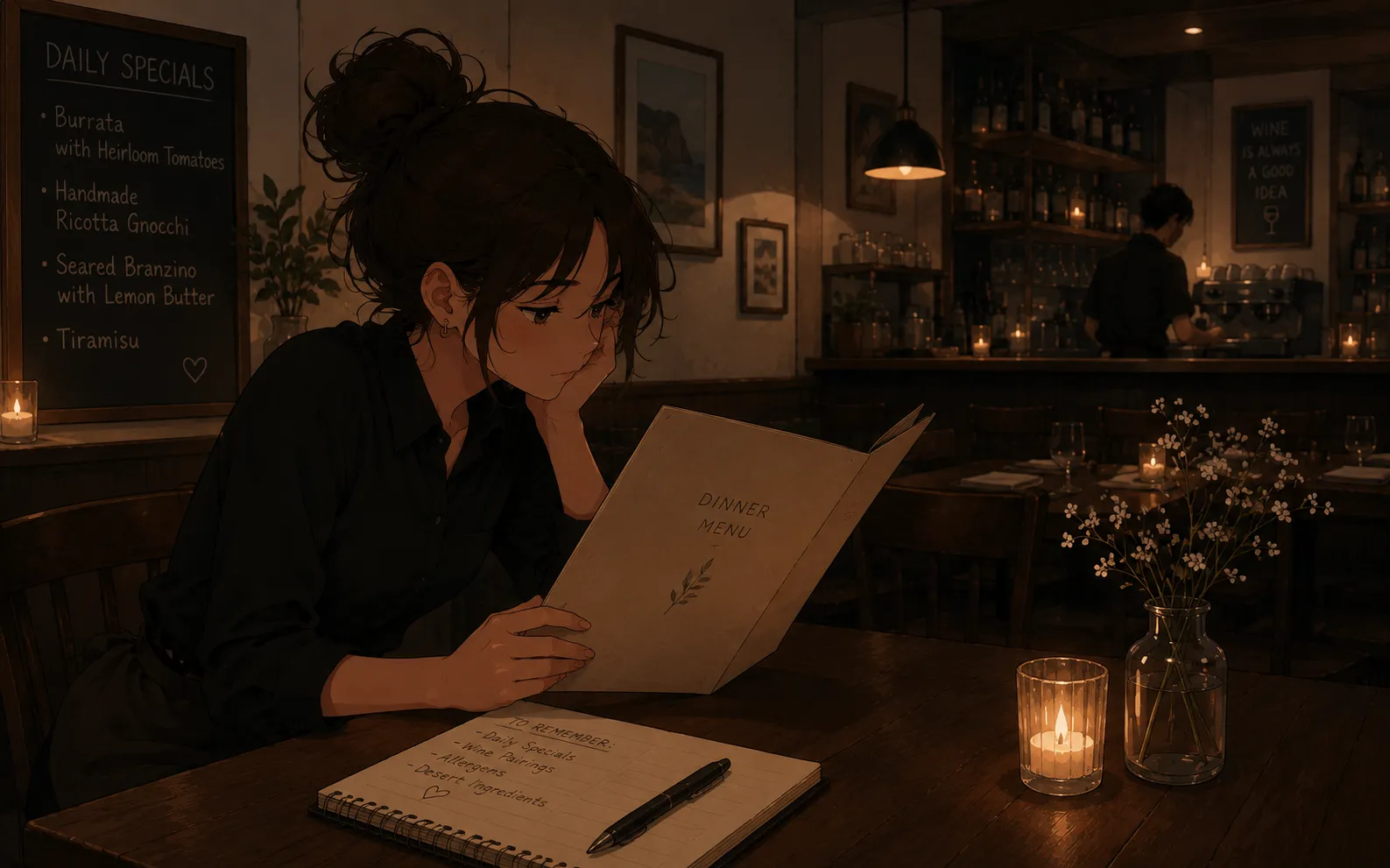
Fine dining asks for two things at once: an intricate menu, dishes with many components, precise techniques, refined ingredients, and the wine pairings that go with them. A guest expects you to describe the dish and recommend the glass beside it without hesitation. That is a lot to hold, and re-reading the menu does not build it. The way top servers do it is to drill the menu and its pairings together as flashcards. An app like MenuFlashcards builds the deck from a photo of the menu and wine list. It is in early access on iPhone.
The base method is how to memorize a restaurant menu fast; this is the fine-dining version, alongside sequence-of-service drills, menu storytelling, and the country-club exam.
Put the dish and its pairing on one card
The key move is to learn the dish and its wine together, not as two separate lists:
| Layer | Example |
|---|---|
| Dish | Seared scallops, pea puree, brown butter |
| Key components | Scallops, pea, brown butter, herbs |
| Allergens | Shellfish, dairy |
| Paired wine | A crisp white, the Chablis by the glass |
| Why it works | Acidity cuts the brown butter |
When the pairing lives on the dish’s card, recalling one brings the other, which is exactly how you speak at the table.
Drill the pairings both ways
Guests approach pairings from both directions: “what wine goes with the scallops?” and “I am drinking this red, what should I order?” So drill it both ways, from dish to wine and from wine to dishes, until either prompt brings the answer. This two-way recall is what separates a server who recites from one who can actually guide a table through a meal.
Learn why each pairing works
Rote pairs are fragile; understanding is durable. Learn the reason behind each pairing, acidity cutting richness, a light wine matching a delicate dish, a bold red standing up to red meat, and the pairings stop being a list to memorize and become a logic you can apply, even to a dish you have not drilled. Wine Folly’s food and wine pairing primer lays out those underlying rules of taste, weight, and intensity in plain language, and reading it once will make every pairing card on your deck easier to remember. The vocabulary, including the French terms, is its own small drill, covered in fine-dining French pronunciation.
Why quizzing beats re-reading the menu
Fine-dining teams hand out detailed menu and wine notes, and reading them feels productive, but it builds recognition, not the precise recall the floor demands. A review of retrieval practice in the National Library of Medicine found that testing yourself produces stronger long-term retention than re-reading. So cover the answer, produce the dish’s components, allergens, and pairing, then check.
A worked example
A guest says “we will both have the scallops, what wine would you suggest?” The unprepared server reaches for the list; the prepared one answers “the Chablis by the glass is lovely with it, the acidity cuts through the brown butter and matches the sweetness of the scallops.” That is the dish, the pairing, and the reason, in one breath, built by quizzing the deck.
Learn the by-the-glass pairings first
A fine-dining wine list can be long, so prioritize the same way a guest’s wallet does: learn the by-the-glass pairings before the rare bottles. Most tables order a glass with their course, not a hundred-dollar bottle, so the by-the-glass list paired to the menu’s signature dishes is the knowledge you will use on almost every table. Drill those pairings to instant recall first, then expand into the full bottle list over time. This also protects you on the floor: even if a guest asks about an obscure bottle you have not mastered, you can confidently steer toward a by-the-glass pairing you know perfectly, which is often what they wanted anyway.
Do not skip allergens, and space it
Intricate dishes hide allergens in sauces and garnishes. In the United States the FDA recognizes nine major allergens, and food allergy affects about one in ten adults, so drill which dishes carry them and what the substitution is, the habit from allergen flashcards for servers. And space your study: research on the spacing effect shows short sessions over several days beat one long cram.
A fast plan
- Photograph the menu and wine list and build the deck.
- Put each dish’s components, allergens, and pairing on one card.
- Drill the pairings both ways, dish to wine and wine to dish.
- Learn why each pairing works, not just the pair.
- Note allergens and substitutions, and space your sessions.
Bottom line
Fine dining rewards knowing the intricate menu and its wine pairings together, so drill them on one card, both directions, with the reasoning, using active recall instead of re-reading notes. MenuFlashcards builds the deck from a photo, and it is in early access, so join the list and start with the free deck when it opens.